
Hydration
Fluid status changes the conductive pathways and is one of the largest sources of variation.
What bioelectrical impedance analysis (BIA) and electrochemical impedance spectroscopy (EIS) measure, how they differ, and what they cannot tell us, especially in research on homoeopathic interventions.
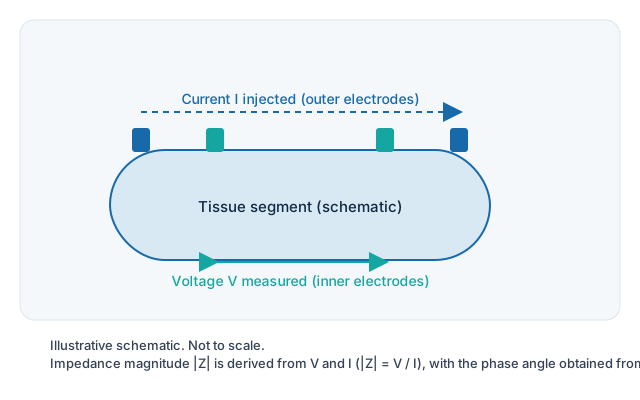
BIA applies a small, safe alternating current through the body and measures the resulting voltage. The ratio gives an impedance, from which a body-composition estimate may be derived.
Most consumer and clinical BIA devices use a single frequency, commonly around 50 kHz, with electrodes on the hands and feet or on the skin of other body segments.
By applying prediction equations that relate impedance, body length and other inputs to measured reference values, such as total body water obtained by dilution methods.
The equations were developed in specific populations. Their accuracy in other groups is not guaranteed, which is why the population and device must always be stated.
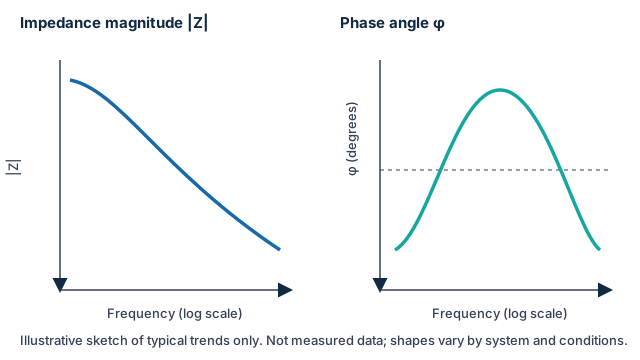
EIS measures impedance across a wide range of frequencies, producing a spectrum. The spectrum is then analysed with an equivalent-circuit model.
EIS is established in electrochemistry, corrosion science, batteries and materials research. Its use in biological and biomedical measurement is more specialised, and results depend heavily on the electrode system and the model chosen.
Impedance is shown as a Nyquist plot (imaginary against real part) or a Bode plot (magnitude and phase against frequency).
Both views are used because each highlights different features of the same data.
The two techniques share physical principles but differ in purpose, design and interpretation.
| Feature | BIA | EIS |
|---|---|---|
| Typical frequency | Often one frequency, or a small set | Wide range, many frequencies |
| Typical output | Impedance and derived body-composition estimates | Impedance spectrum and fitted model parameters |
| Main setting | Clinical, nutritional and fitness settings | Laboratory and materials research, with specialised biomedical use |
| Key assumptions | Prediction equations fit the population studied | The equivalent-circuit model fits the system studied |
| Main limitation | Sensitive to hydration, posture and device | Sensitive to electrode system, model choice and setup |
Phase angle is the lag between the applied current and the resulting voltage, from which the reactance-to-resistance ratio is derived.
It is calculated as φ = arctan(X / R), where X is reactance and R is resistance. It is reported in degrees or radians. Its interpretation depends on the population, frequency and device, so comparisons must use the same settings.
Many factors change the measured value without any change in the underlying tissue. Good protocols control or record them.
Fluid status changes the conductive pathways and is one of the largest sources of variation.
Skin and ambient temperature alter electrolyte conduction and electrode contact.
Body position, recent exercise, food, bladder state and time of day can all matter.
Small changes in placement or skin preparation can change the measured voltage.
Different models use different frequencies, algorithms and prediction equations.
Pacemakers, implants, pregnancy and oedema affect validity and need to be recorded.
No. They share principles, but EIS uses a wide frequency range and spectral analysis, while BIA is usually a simpler device-based measurement.
Only if its validity and repeatability have been checked for that purpose.
Consumer devices may lack the calibration, documentation and standard protocols that research requires.
No. This is educational content only and is not a substitute for advice from a qualified clinician.
Start with the references on the subject foundations page, then check the glossary for definitions.